
 People often say they need something specific to generate more energy and are disappointed when they never seem to have enough of it. I suspect this gap occurs because we focus on the things that gives us energy instead of the processes we set up.
Think about it: How often have we been asked, “What gives you energy?” How often have you been asked, “How do you produce energy?” Maybe it’s the “how,” not the “what,” we should seek. After all, we have more control over the “how.” As I reflect on this, I want to share a few ways you can create positive, helpful energy:
0 Comments
 After completing a post activity report (PAR) for a recent project, Anita and I discussed the wisdom of having a backup plan.
Yes, we complete a PAR for every project, which we talk about more here. But this post is really about dealing with yet another winter storm this long winter, and the plan we created to mitigate the risk of weather. Creating a backup plan extends our strategic approach for achieving our client’s goal, which is our most important goal.  It’s hard to take time for yourself when the calendar is full, but I’m learning that might be the perfect time to do so.
Recently, Rachel and I took an online course on self-compassion from experts Kristin Neff – if you’ve ever heard anyone referencing self-compassion, it was likely her! – and Chris Germer. They have been working together since 2010. We didn’t have an extra 12 hours in our schedule, but making time for that course was worth it. We want to be the best human beings and project managers that we can be. We accomplish this by learning, growing, and expanding our thinking.  It can be hard to ask for help.
We have been programmed to believe that strength is individual, that asking for help is a sign of weakness. This mentality, however, deprives us of the power that can come from working together, instead of alone. At Reach Partners, we have observed that good leaders recognize that they can’t do everything alone. We’ve seen that the best leaders take that one step further; they know how to ask for exactly what they need while empowering others to contribute. Here’s how that played out recently:  When times and projects are rough, we have some advice: grab chocolate and a project manager.
It’s likely not surprising to you that we would recommend a project manager. The chocolate might be a bigger mystery. But eating chocolate (or another favorite treat) is one of the many ways leaders can ground themselves amid stress. In recognition of this, here are three ways you can mitigate panic and stress when projects go awry. The following is good counsel for all of us. It’s an especially busy time for Anita and me. We hear it’s the same for our clients, trusted vendors and friends. While I write this for you, the advice is really for me.  There’s a common saying that fences make good neighbors.
The underlying assumption is that people get along better when there is separation, that relationships need defined space. We disagree. Our best work happens when people break down those fences and come together. We believe that collaboration leads to the best ideas and the best path forward. We know from experience that we can do more together than alone. 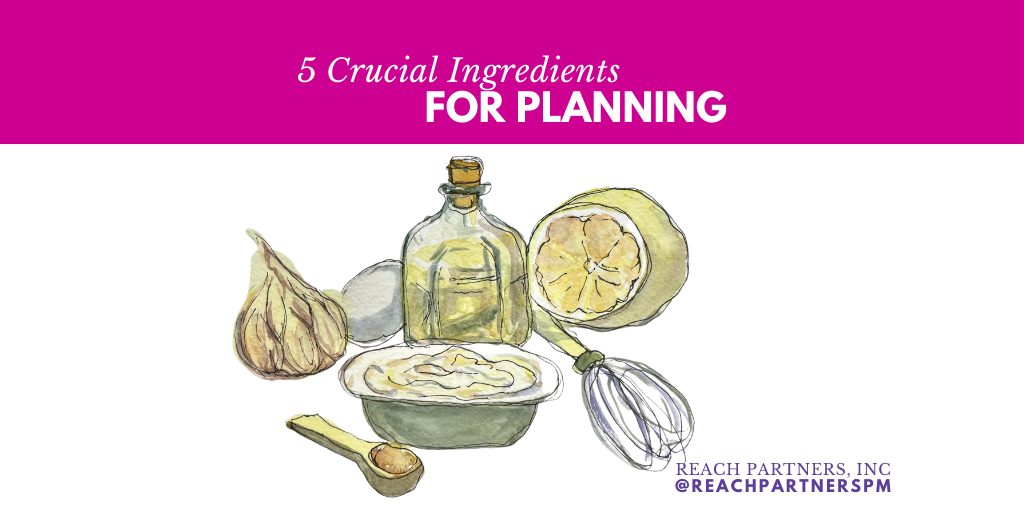 All it takes are five simple ingredients to add creamy flavor to fried potatoes and punch to baked salmon. Those same five ingredients can serve as a base for a scrummy potato salad and the unsung heroes of a BLT sandwich.
When you combine garlic, mustard, egg, oil and lemon, you get an unforgettable garlicky mayonnaise, also known as aioli. Those individual ingredients are certainly tasty, but they become magical when combined. By slowly adding oil while whipping the other ingredients, the liquids emulsify and create a custard-like spread. Yum! Like mayo, the ingredients for a planning process are simple. Yet they form something new when combined. When blended, purpose, people, time, communication, and action become key ingredients to projects, events and collaborations we deem successful.  This year, Reach Partners celebrates 20 years.
Twenty years! That’s countless hours of coordinating events, gathering people in conversation, helping work get done, communicating key messages, training volunteers, facilitating meetings, pushing and encouraging, staying within budget, outlining the scope, staying up late, waking up early, making mistakes, asking forgiveness, and making right the mistakes we made. Twenty years! As we celebrate this milestone, we recognize that we are who we are largely because of the values that we uphold and practice. We are intentional about how we do our work and who we do it with. This has led us to the best partners a business could ask for and we are immensely grateful for that. So, in honor of our anniversary, we want to reflect on a few moments from the past two decades that speak to our values. Of course, there are so many more moments than we have space for, but here is a sampling:  At some point, nearly every organization needs to hire an outside vendor or consultant.
Maybe you need help with accounting or a website redesign. Maybe you need someone to help you organize an upcoming event; or maybe you need someone to lead your team training. Whatever you need, be sure to seek a partner – and not just a vendor or a consultant. What’s the difference? It starts with intent.  I’ve always enjoyed reading, and I’ve become a better reader thanks to my book club. Armed with their encouragement and suggestions, I read a larger array of genres. I’ve also learned that I like to listen to audible books checked out through the library, a habit that recently led me to listen to Matthew McConaughey’s book, Greenlights.
It was okay, maybe even good. I listened to the book at normal speed the entire time, which is telling. That’s usually how I start an audiobook, but not how I end it. I either speed it up, wanting it to end soon or slow the tempo, wanting to bask in a text’s poetic beauty. Still, let’s face it, it wasn’t a bad deal to have Matthew talk to me during drive time. Memoirs are not my favorite genre but I have found that I don’t get bored if it doesn’t follow a chronological order of the person’s life but tells stories centered around themes. But the part of the book that sticks with me is when McConaughey shared this observation: “If you know how, and when, to deal with life’s challenges – how to get relative with the inevitable – you can enjoy a state of success I call ‘catching greenlights.’” |